The landscape of educational assessment is undergoing a profound transformation. Gone are the days when quizzes and tests served merely as summative checkpoints. Today, AI-powered analytics are turning every assessment into a rich source of actionable insights, enabling educators to understand not just what students know, but how they learn, where they struggle, and what interventions will be most effective.
Beyond Grades: The New Paradigm of Assessment Analytics
Traditional assessment focused primarily on one metric: the grade. A student scored 85% on a quiz, and that number became their entire story. But AI-powered analytics reveal the chapters behind that number. How long did they spend on each question? Which concepts did they master immediately, and which required multiple attempts? What patterns in their responses indicate deeper understanding versus surface-level memorization?
This shift from summative to formative intelligence represents one of the most significant advances in educational technology. Modern assessment platforms don't just measure learning—they illuminate the learning process itself.
Key Components of AI Assessment Analytics
- Performance Tracking: Real-time monitoring of individual and class-wide progress
- Learning Pattern Recognition: AI identifies how students approach problems and process information
- Predictive Analytics: Early warning systems for students at risk of falling behind
- Gap Analysis: Automatic identification of concept gaps and prerequisite knowledge deficiencies
- Time-on-Task Analytics: Understanding how time investment correlates with performance
- Comparative Benchmarking: Contextualizing performance against class, school, or national standards
How AI Transforms Raw Data into Insights
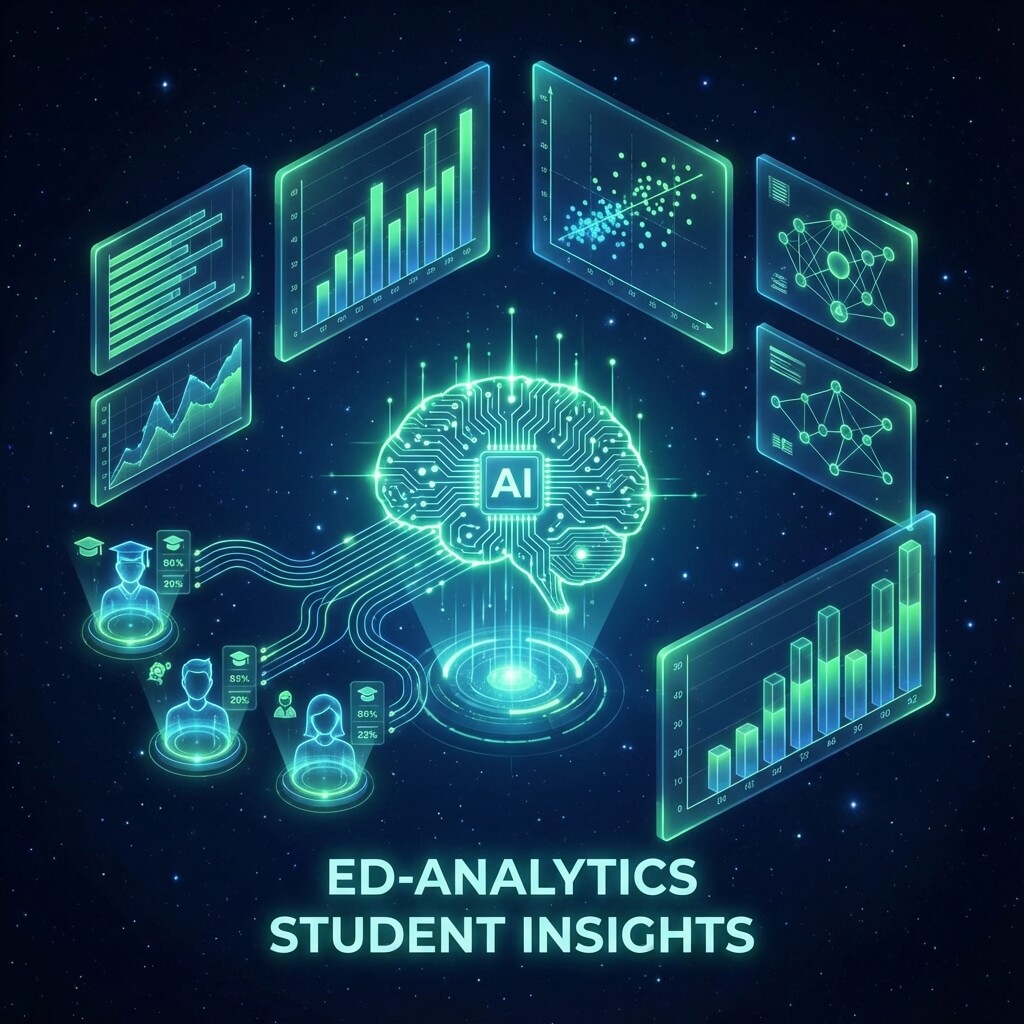
The magic of AI analytics lies in its ability to process vast amounts of data and extract meaningful patterns that would be invisible to human observers. When a student takes a quiz, the AI captures dozens of data points: response times, answer changes, question skip patterns, confidence indicators, and more.
Machine learning algorithms then analyze this data across multiple dimensions, identifying correlations and trends. For example, the AI might discover that students who spend less than 30 seconds on complex questions tend to score lower overall—suggesting impulsive responding rather than careful consideration. Or it might find that certain question sequences lead to better learning outcomes.
"Data without insight is just noise. AI transforms assessment data into a narrative about each student's learning journey, helping educators make informed decisions that genuinely improve outcomes."
— Dr. Michael Torres, Director of Educational Data Science at MIT
Predictive Analytics: Seeing the Future of Student Success
Perhaps the most powerful application of AI in assessment is predictive analytics. By analyzing historical performance data alongside current assessment results, AI can forecast student outcomes with remarkable accuracy. This allows educators to intervene before problems become crises.
Research shows that AI-powered early warning systems can identify at-risk students with up to 85% accuracy, weeks or even months before traditional indicators would raise concerns. This proactive approach transforms education from reactive problem-solving to preventive support.
- Early Warning Indicators: Declining engagement patterns, increasing time-on-task, response consistency changes
- Intervention Recommendations: AI suggests specific actions based on individual student profiles
- Success Probability Modeling: Forecasting likely outcomes based on current trajectories
- Resource Optimization: Identifying where additional support will have the greatest impact
Personalized Learning Pathways
AI analytics enable true personalization at scale. Rather than one-size-fits-all instruction, educators can use assessment insights to create individualized learning pathways for each student. The AI identifies not just what a student needs to learn, but how they learn best.
Some students thrive with spaced repetition, while others benefit from intensive practice sessions. Some learn better through visual representations, while others prefer text-based explanations. AI analytics reveal these preferences and adapt recommendations accordingly.
Real-Time Feedback and Adaptive Assessment
Modern AI-powered assessments don't wait until the end to provide feedback. They adapt in real-time, adjusting question difficulty, providing hints when students struggle, and offering immediate explanations for incorrect responses. This transforms assessment from a judgment event into a learning opportunity.
Adaptive testing algorithms can accurately measure student knowledge in fewer questions than traditional fixed-form tests. By dynamically selecting questions based on previous responses, AI assessments are both more efficient and more precise.
Privacy and Ethical Considerations
With great analytical power comes great responsibility. AI assessment analytics must be implemented with careful attention to student privacy and data security. Best practices include data anonymization, secure storage, transparent data usage policies, and giving students and parents control over their information.
Equally important is avoiding algorithmic bias. AI systems must be regularly audited to ensure they don't disadvantage particular student populations. The goal is to use AI to reduce—not amplify—educational inequities.
Implementing AI Analytics in Your Institution
Transitioning to AI-powered assessment analytics doesn't require a complete overhaul of existing systems. Many platforms, including AdvanceQuiz, integrate seamlessly with current workflows while adding powerful analytical capabilities. The key is to start small, perhaps with a single course or subject, and gradually expand as educators become comfortable interpreting and acting on the insights.
- Start with clear goals: What questions do you want your data to answer?
- Choose the right platform: Look for intuitive dashboards and actionable insights
- Train your team: Ensure educators understand how to interpret and use analytics
- Establish feedback loops: Regularly review whether analytics are improving outcomes
- Iterate and improve: Use insights to continuously refine your assessment strategy
The Future is Data-Informed
The future of education lies at the intersection of human expertise and artificial intelligence. AI analytics don't replace the irreplaceable judgment, creativity, and empathy of skilled educators. Instead, they amplify these qualities by providing the information educators need to make better decisions.
As AI technology continues to advance, we can expect even more sophisticated analytical capabilities: real-time emotion detection, multimodal assessment analysis, and increasingly accurate predictive models. The educators who embrace these tools today will be best positioned to provide exceptional learning experiences tomorrow.
Conclusion
AI-powered assessment analytics represent a fundamental shift in how we understand and improve learning. By transforming every quiz and test into a source of deep insight, these tools empower educators to personalize instruction, identify struggling students early, and continuously optimize their teaching strategies. The future of assessment is not just about measuring knowledge—it's about understanding the journey of learning itself.
Ready to Transform Your Quiz Creation?
Join thousands of educators using AI to create engaging assessments in seconds.
Get Started Free