There is a quiet moment in every classroom—paper-and-pencil or digital—when students read a quiz question and either connect with the material or stare blankly. That small moment determines whether the quiz is a learning experience or just a grading exercise. The difference comes down to how the questions are written.
Bad quiz questions measure test-taking skill. Good quiz questions measure understanding. Great quiz questions actually teach—they force students to retrieve, reorganize, and apply knowledge in ways that strengthen long-term retention. Writing great questions is a craft, and like any craft, it improves with clear principles and deliberate practice.
Over the past decade, cognitive science research on retrieval practice, desirable difficulty, and formative assessment has reshaped our understanding of what makes a quiz effective. The following twelve practices draw on that research and on practical classroom experience.
1. Start with the Learning Objective, Not the Content
The most common mistake in quiz creation is opening a textbook chapter and highlighting facts to turn into questions. This approach produces quizzes that test random knowledge rather than targeted skills. Instead, begin with your learning objectives. What should students be able to do after this unit? Your quiz questions should directly measure those abilities.
For example, if your objective is 'Students will be able to compare and contrast mitosis and meiosis,' your quiz should not simply ask 'How many chromosomes result from meiosis?' That is a recall question. A better question presents a scenario and asks students to identify which process is occurring and explain why—directly testing the comparison skill you taught.
2. Write the Question Before the Answer Choices
This sounds obvious, but many quiz writers draft the question and answer choices simultaneously, which leads to the stem being shaped around a particular correct answer rather than around the concept being tested. Write the question stem first. Make sure it poses a complete, clear problem. Only then write the correct answer, and finally compose distractors. This order produces cleaner, more focused questions.
3. Make Distractors Do Pedagogical Work
In a well-designed multiple-choice question, every wrong answer should represent a real misconception or common error. Distractors serve a diagnostic function: if many students select a particular wrong answer, you learn something specific about what they misunderstand. Random or obviously wrong options ('all of the above,' 'none of the above,' or joke answers) waste this diagnostic opportunity.
Consider a question about Newton's Third Law. A strong distractor might reflect the common belief that action forces are stronger than reaction forces—a real misconception. When 40 percent of the class selects this option, you know exactly what to re-teach, and you know it immediately rather than after grading essays.
- Each distractor should be plausible to a student with a specific gap in understanding
- Avoid 'All of the above' — students who identify two correct options will select it without evaluating the third
- Avoid 'None of the above' — it tests process of elimination rather than knowledge
- Keep all options similar in length, complexity, and grammatical structure to prevent cuing
4. Use Clear, Direct Language
Quiz questions should test content knowledge, not reading comprehension (unless reading comprehension is your objective). Avoid double negatives, convoluted sentence structures, and unnecessary jargon. If a student who understands the material could still get confused by the question's wording, the question is poorly written.
A common offender is the negative stem: 'Which of the following is NOT a characteristic of...' Students frequently miss the word NOT and answer incorrectly despite knowing the material. If you must use a negative stem, bold and capitalize the negative word. Better yet, rephrase the question positively.
5. Vary Question Types Intentionally
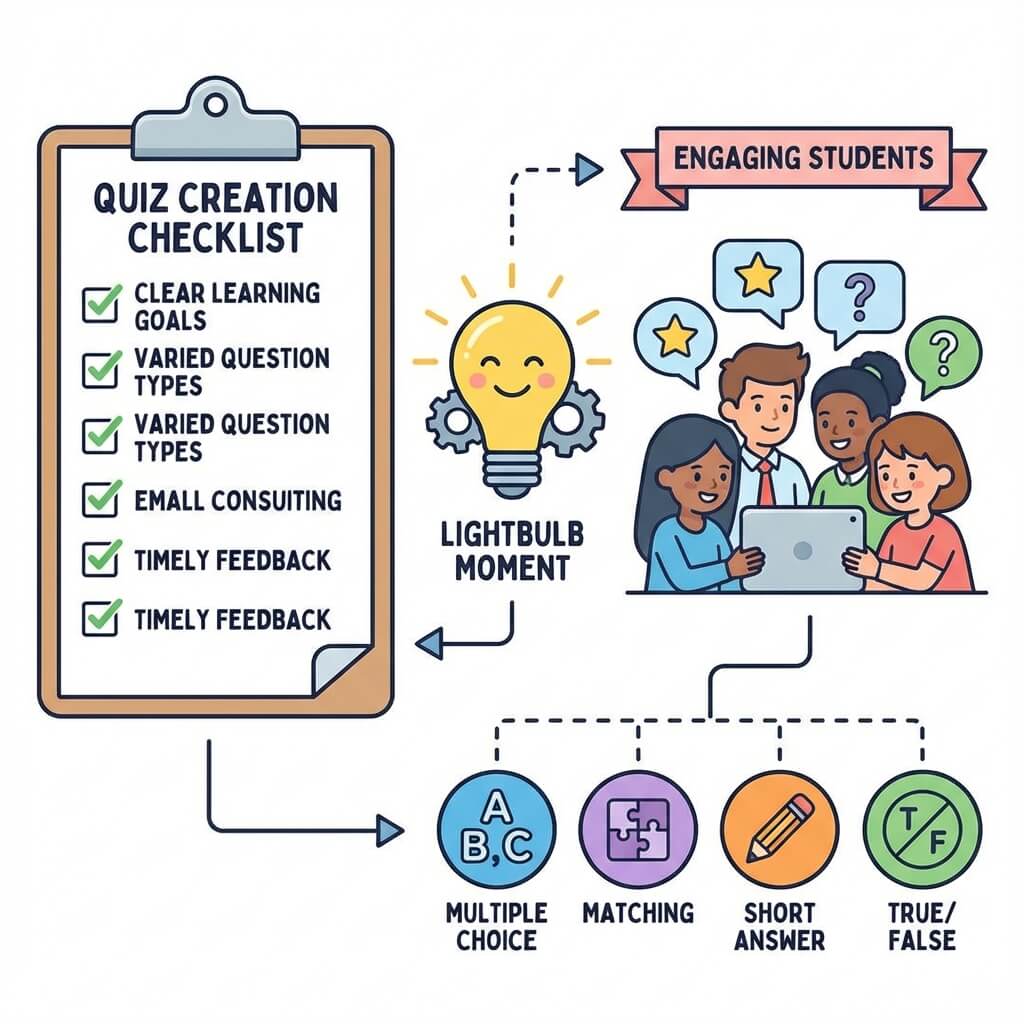
Different question types test different cognitive skills. Multiple-choice tests recognition. Fill-in-the-blank tests recall (which is harder and produces better learning). True/false tests the ability to evaluate a specific claim. Short answer tests articulation and construction of knowledge. Use variety not for its own sake but because different learning objectives require different assessment methods.
A quiz on vocabulary might use fill-in-the-blank (pure recall). A quiz on historical causation might use multiple-choice with scenario prompts (application). A quiz on mathematical procedures might use short answer (demonstration of process). Match the question type to the skill you are assessing.
6. Embrace Desirable Difficulty
Cognitive science research by Robert Bjork demonstrates that learning is stronger when retrieval is effortful. Questions that are too easy produce correct answers but minimal learning. Questions that require genuine mental effort—recall rather than recognition, application rather than regurgitation—create stronger memory traces.
This does not mean making questions tricky or unfair. It means designing questions that require students to think, not just remember. Instead of asking 'What is the capital of France?' ask 'A multinational company is choosing a central European location for its headquarters. Considering geographic, economic, and political factors, explain why Paris would or would not be an effective choice.' Same underlying knowledge, vastly different cognitive demand.
7. Include Answer Explanations
A quiz without feedback is a missed learning opportunity. When a student gets a question wrong, the moment of maximum learning readiness is immediately after they see their result. If the quiz provides an explanation—not just the correct answer but why it is correct and why the student's choice was wrong—the assessment becomes a powerful learning event.
The testing effect is most powerful when students receive elaborative feedback after each question. Correct answer alone improves retention moderately; correct answer with explanation improves retention substantially.
— Roediger & Butler, 2011
Writing explanations takes time, but it is time that multiplies the educational value of every quiz. Many AI quiz generation tools can draft answer explanations automatically, which significantly reduces the workload while maintaining the pedagogical benefit.
8. Test One Concept per Question
Double-barreled questions—those that test two concepts simultaneously—make it impossible to diagnose where a student's understanding breaks down. If a question asks about both the cause and the effect of an event, and the student answers incorrectly, you do not know which part they misunderstood. Split complex ideas into separate questions. Each question should have one correct answer for one clear reason.
9. Balance Coverage Across the Material
Teachers naturally write more questions about material they find interesting or recently taught. This leads to uneven assessment coverage. Before writing questions, create a simple blueprint listing the topics or objectives the quiz should cover and how many questions each should receive. This quiz blueprint (sometimes called a test specification table) ensures the assessment represents the full scope of what students learned.
A practical approach: list your learning objectives in one column. In the next column, write the number of questions each objective deserves based on its importance and the time spent teaching it. Use this as a checklist while creating or reviewing your quiz.
10. Pilot Questions Before High-Stakes Use
Professional test developers never deploy a question without piloting it first. You can do something similar on a smaller scale. Use new questions on a low-stakes practice quiz before including them on a graded exam. Review the results: if everyone gets a question right, it may be too easy. If almost everyone gets it wrong, the question may be flawed (ambiguous wording, incorrect answer key, or testing something not adequately taught). Item analysis does not require complex statistics—even noting the percentage of students who chose each option reveals a lot.
11. Consider the Student Experience
Read through your quiz as if you were a student encountering it for the first time. Is the flow logical? Are the instructions clear? Is the difficulty progression reasonable, or does the quiz start with the hardest questions and demoralize students before they reach items they can answer? Small design choices—clear numbering, adequate spacing, consistent formatting—reduce test anxiety and help students perform at their actual knowledge level.
For digital quizzes, ensure they work well on mobile devices. Many students access online assessments from phones, and poorly formatted quizzes on small screens create an unnecessary barrier. Preview your quiz on a phone screen before assigning it.
12. Review and Iterate After Every Quiz
The most powerful practice is the simplest: after giving a quiz, review how it performed. Which questions did students struggle with? Were the struggles due to lack of understanding (good—the question did its job) or due to confusing wording (bad—the question failed its job)? Keep a personal question bank and tag questions as 'works well,' 'needs revision,' or 'retire.' Over time, your question bank becomes a refined, reliable assessment resource.
Quiz creation is not a one-time activity but an ongoing refinement process. Each administration gives you data. Each data point informs a revision. If you approach quiz creation with this iterative mindset, your assessments will steadily improve in quality, fairness, and pedagogical impact—quiz by quiz, semester by semester.
Putting It All Together
No single practice transforms a quiz from forgettable to effective. It is the combination—aligning questions to objectives, crafting diagnostic distractors, including explanations, balancing coverage, and iterating based on data—that produces assessments students genuinely learn from. These twelve practices represent what research and classroom experience consistently show works.
If you are just starting to improve your quiz design, pick two or three practices from this list and apply them to your next quiz. Observe the difference in student performance and engagement. Then add more practices gradually. The goal is not perfection on day one but steady improvement over time. Your students will notice the difference before you do.
Ready to Transform Your Quiz Creation?
Join thousands of educators using AI to create engaging assessments in seconds.
Get Started Free