If you ask most students how they study, you will hear familiar answers: re-read the textbook, review notes, highlight important passages, maybe watch a video lecture a second time. These strategies feel productive. Highlighting gives a sense of progress. Re-reading feels like reinforcement. But decades of cognitive science research demonstrate conclusively that these passive strategies are among the least effective methods for long-term learning.
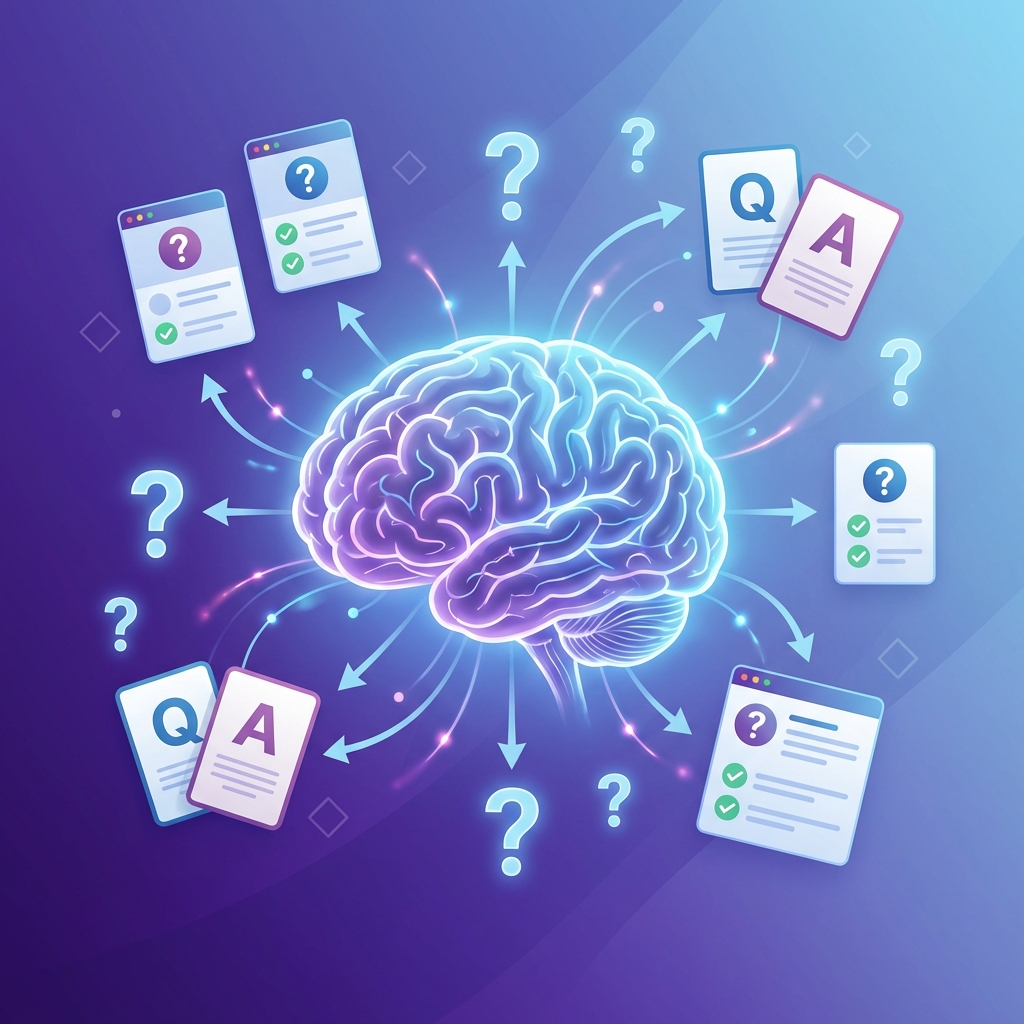
The method that consistently outperforms all others in controlled studies is active recall—the practice of retrieving information from memory without looking at the source material. In simpler terms: testing yourself. Taking a quiz, answering flashcard questions, or writing down everything you remember about a topic from memory are all forms of active recall. And they work remarkably well, for reasons that are now well understood at a neurological level.
What Active Recall Actually Does to Your Brain
When you re-read a passage, your brain processes it passively. The information enters working memory, registers as familiar, and creates an illusion of knowing. You recognize the material when you see it, so you feel like you know it. But recognition and recall are two very different cognitive processes, and exams test recall—the ability to produce information without cues.
Active recall forces a different neurological process. When you attempt to retrieve information from memory, you activate and strengthen the neural pathways associated with that knowledge. Each retrieval attempt makes the pathway slightly more robust, making future retrieval easier. This is why testing yourself even once—before you feel ready—produces better retention than multiple re-readings.
Neuroscience research using brain imaging confirms this mechanism. During active recall, the hippocampus and prefrontal cortex show significantly higher activation compared to passive study. This heightened neural activity is the biological signature of deeper memory encoding.
The Evidence: Testing Effect Studies
The testing effect—the finding that taking a test on material improves long-term retention more than additional study—is one of the most robust findings in educational psychology. Hundreds of studies have replicated it across age groups, subjects, and settings.
In a landmark study by Jeffrey Karpicke and Henry Roediger at Washington University in St. Louis, students who practiced retrieval retained 80 percent of material after a week, while students who re-read retained only 36 percent. The retrieval practice group studied the material fewer times overall but remembered dramatically more. This finding has been replicated consistently—the advantage of testing over re-reading is large and reliable.
Importantly, the benefit of testing occurs even when students get the answers wrong during practice retrieval. The act of attempting to recall—struggling with the question, searching memory—strengthens the eventual encoding of the correct answer. This is counterintuitive but well-documented: effortful, even unsuccessful, retrieval attempts enhance learning.
Why Students Avoid Active Recall
If active recall is so effective, why do most students default to passive strategies? The answer lies in a psychological phenomenon called the fluency illusion. When you re-read material, it becomes familiar, and that familiarity feels like learning. Each time you read a passage, it flows more easily, creating the subjective experience of mastery. But this fluency is an illusion—it represents familiarity, not understanding or recall ability.
Active recall, by contrast, feels harder. When you close the book and try to remember what you just read, you struggle. You forget things. You feel uncertain. This discomfort creates the false impression that the strategy is not working—but in reality, it is precisely this desirable difficulty that produces deeper learning.
The challenge for educators and students is to trust the uncomfortable process. Learning that feels easy often is not lasting. Learning that feels effortful often is.
The most effective learning strategies are the ones that feel the least comfortable in the moment. Easy studying leads to fragile knowledge. Difficult retrieval leads to durable understanding.
— Dr. Robert Bjork, Distinguished Professor of Psychology, UCLA
Spaced Retrieval: Combining Recall with Timing
Active recall becomes even more powerful when combined with spaced practice—distributing retrieval attempts over increasing intervals rather than cramming them into a single session. This combination, known as spaced retrieval, exploits the spacing effect, another well-established finding in memory research.
The spacing effect shows that information reviewed at intervals is retained much longer than information reviewed repeatedly in one sitting. When you quiz yourself on Tuesday, again on Friday, and once more the following Wednesday, each retrieval event reinforces the memory more effectively than three reviews on Tuesday alone.
Digital quiz platforms are particularly well-suited to implementing spaced retrieval because they can track what a student has already been tested on and schedule reviews at optimal intervals. Rather than manually planning review sessions, students can use automated systems that present material for re-testing at precisely the right time.
How Quizzes Serve as the Perfect Active Recall Tool
Quizzes are perhaps the most practical vehicle for active recall because they structure the retrieval process. Rather than asking students to 'think about what you learned'—which is vague and often unproductive—a quiz provides specific prompts that target particular concepts. Each question is a focused retrieval cue.
- Multiple-choice questions test recognition and discrimination—can the student identify the correct answer among plausible alternatives?
- Fill-in-the-blank questions test pure recall—can the student produce the answer from memory?
- Short-answer questions test comprehension—can the student explain a concept in their own words?
- Application questions test transfer—can the student use knowledge in a new context?
- Each question type activates slightly different retrieval processes, which is why varied quiz formats produce better overall retention than any single format alone.
Practical Applications for Students
Students can harness active recall immediately with minimal effort. Here are concrete strategies:
- After reading a chapter or attending a lecture, close your materials and write down everything you remember. Then open your notes and check what you missed. The gaps reveal exactly what needs more attention.
- Use or create practice quizzes for every topic. Digital tools like AdvanceQuiz can generate quiz questions from your study materials automatically, saving the time of creating questions manually.
- Space your review sessions. Do not cram. Take a practice quiz on Monday, revisit the missed questions on Thursday, and test yourself again the following week.
- Answer before looking. When reviewing flashcards or quiz questions, always attempt an answer before flipping to the solution. Even a wrong guess primes your brain for encoding the correct answer.
- Study with a partner by quizzing each other. Explaining an answer aloud is an especially powerful form of retrieval because it requires you to organize your knowledge coherently.
Practical Applications for Teachers
Teachers can build retrieval practice into their courses without consuming significant class time. Low-stakes daily quizzes of three to five questions—ungraded or worth minimal points—are one of the most effective interventions documented in educational research. They require only five minutes of class time but substantially improve both learning and engagement.
Cumulative quizzes that include questions from previous units are particularly valuable because they space out retrieval across the entire course. Instead of reviewing Unit 1 only during Unit 1, students encounter Unit 1 questions in Units 2, 3, and 4—keeping the knowledge active and integrated.
AI-powered quiz generation makes this practical at scale. Rather than manually writing hundreds of cumulative questions across all units, teachers can generate quiz banks from their course materials and let the technology handle the distribution of topics across practice sessions.
Overcoming Common Objections
Some educators worry that frequent quizzing creates test anxiety. Research suggests the opposite: low-stakes practice quizzes actually reduce anxiety on high-stakes tests because students become accustomed to the retrieval process. When testing is a regular, non-threatening part of the learning routine, it loses its anxiety-inducing power.
Others worry about the time cost. But a five-minute daily quiz replaces five minutes of less effective instruction—not additional time. The net result is better learning in the same total time.
The Bottom Line
Active recall through quizzing is not a trend or a theory—it is one of the most empirically supported learning strategies in all of cognitive science. Students who test themselves learn more, remember longer, and perform better on actual exams. Teachers who incorporate frequent low-stakes quizzes see measurable improvements in student outcomes.
The takeaway is simple: stop re-reading and start retrieving. Close the book and quiz yourself. If you are a teacher, quiz your students early and often. The science is clear, the tools are accessible, and the results speak for themselves.
Ready to Transform Your Quiz Creation?
Join thousands of educators using AI to create engaging assessments in seconds.
Get Started Free