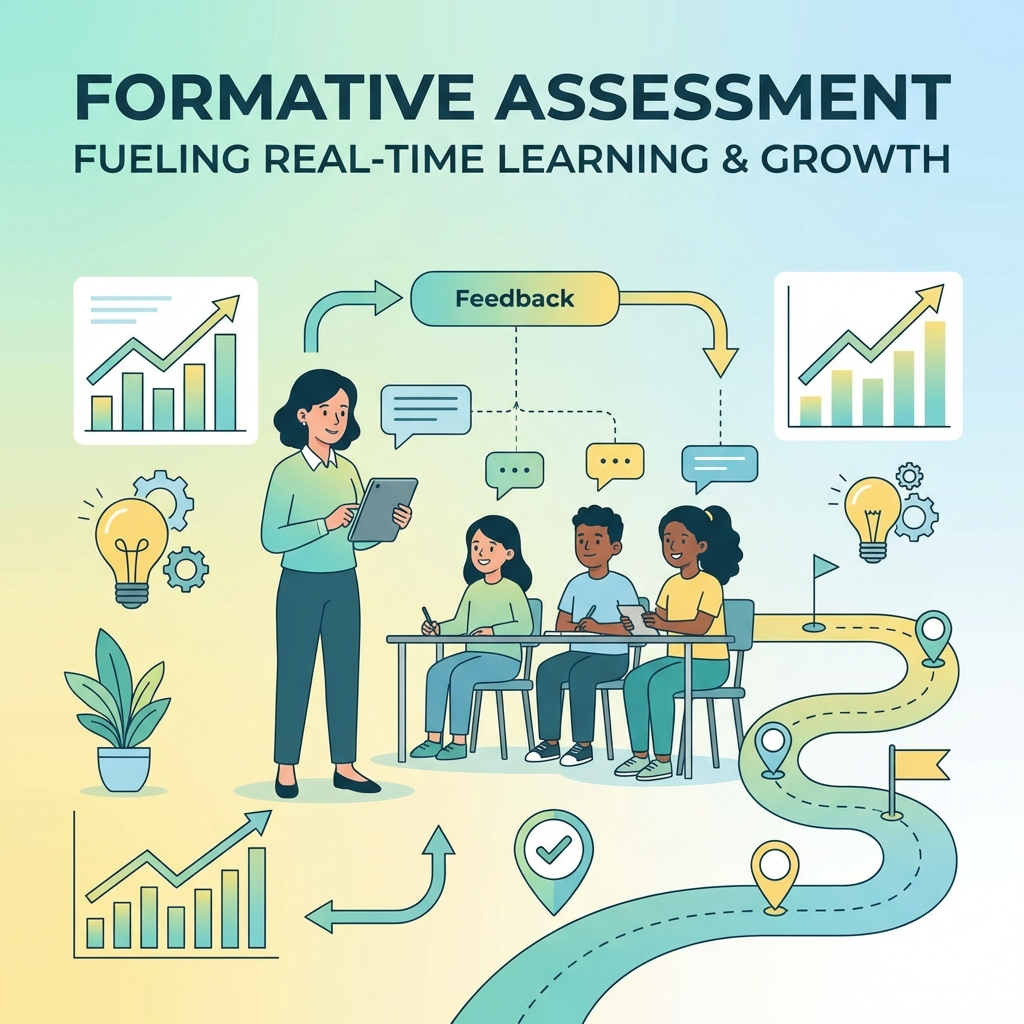
Every teacher knows the sinking feeling. You spend weeks teaching a unit, your students nod along, homework gets handed in, and then the test results come back—and half the class missed fundamental concepts you thought they understood. The problem is rarely with your teaching. It is with when and how you assessed understanding. Traditional end-of-unit tests catch gaps far too late. Formative assessment changes this entirely.
Formative assessment is not a new idea, but its importance has never been more clear. At its core, formative assessment means checking for understanding during the learning process, not just at the end. It is the difference between a GPS that recalculates your route in real time and one that only tells you after arrival that you drove to the wrong city. Research consistently shows that classrooms using regular formative assessments see measurably stronger learning gains compared to those relying on summative tests alone.
What Exactly Is Formative Assessment?
Formative assessment is any activity that gives teachers and students information about learning while it is still happening. Unlike summative assessment—final exams, standardized tests, end-of-term projects—formative assessment is designed to inform and adjust instruction in the moment. It does not carry high-stakes grades. Instead, it serves as a feedback loop that benefits both the instructor and the learner.
Think of it practically. When a chef tastes soup while cooking, that is formative assessment. Waiting until the dinner guests try it is summative. Both have a role, but only the first one gives you a chance to fix the seasoning before it matters. In a classroom, formative assessment might look like a quick five-question quiz at the end of a lesson, an exit ticket where students explain one concept in their own words, or a polling question that reveals whether the class grasped a key idea.
The Research Behind Formative Assessment
The evidence supporting formative assessment is extensive. Paul Black and Dylan Wiliam's landmark 1998 review of over 250 studies concluded that formative assessment produces significant learning gains, with effect sizes between 0.4 and 0.7—among the largest of any educational intervention. To put that in perspective, an effect size of 0.7 is roughly equivalent to moving a student from the 50th percentile to the 76th percentile.
More recent work by John Hattie, whose Visible Learning research synthesized over 1,500 meta-analyses encompassing millions of students, ranked feedback—a core element of formative assessment—among the top ten influences on student achievement. The reason is straightforward: formative assessment creates a continuous cycle of teaching, checking, adjusting, and reteaching. Students do not fall behind silently because the teacher catches misunderstandings early.
What makes these findings particularly compelling is their consistency across age groups, subjects, and school settings. Whether the students are first graders learning addition or university undergraduates studying organic chemistry, formative assessment reliably improves outcomes.
Why Traditional Testing Falls Short
Traditional tests are not inherently bad—they serve a legitimate purpose in certifying knowledge and comparing performance. The problem arises when they are the only assessment tool in a teacher's toolkit. A unit test administered after three weeks of instruction tells you what students learned, but it cannot tell them in time to learn it better. The feedback comes too late for the current unit, and students often do not revisit their mistakes because the class has already moved on.
There is also the anxiety factor. High-stakes testing triggers stress responses that can impair cognitive function, particularly in students who already struggle with confidence. Research from the University of Chicago has shown that math anxiety alone causes measurable declines in working memory capacity during tests, meaning anxious students may actually know more than their test scores suggest.
Formative assessment removes much of this pressure. Because it is low-stakes and frequent, students begin to see assessment as a normal part of learning rather than a threatening judgment of their ability. Over time, this shift in perception reduces test anxiety even during summative assessments.
Practical Formative Assessment Techniques
The best formative assessments are quick, easy to administer, and immediately informative. You do not need expensive tools or elaborate rubrics. Here are techniques that experienced teachers swear by, organized from simplest to most structured:
- Exit Tickets — Students write one thing they learned and one thing they are still confused about before leaving class. Takes two minutes but gives you overnight to adjust the next lesson.
- Think-Pair-Share — Pose a question, let students think individually, discuss with a partner, then share with the class. You can circulate during the pair stage and instantly gauge understanding.
- Mini Quizzes — Short, ungraded quizzes of five to ten questions administered at the start or end of class. Digital tools like AdvanceQuiz make this especially efficient because results are available immediately.
- Whiteboard Responses — Students hold up answers on individual whiteboards simultaneously. Every student responds, so you see the whole class at a glance instead of hearing from the same three raised hands.
- One-Sentence Summary — Ask students to summarize the main idea in exactly one sentence. This forces them to distill their understanding and reveals whether they grasped the core concept.
- Concept Maps — Students create visual representations of how ideas connect. These maps make their mental models visible and often reveal surprising gaps or misconceptions.
How Digital Tools Amplify Formative Assessment
While formative assessment can absolutely be done with nothing more than pen and paper, digital tools address one of its biggest challenges: speed. When you have 30 students in a room and 50 minutes to teach, manually reading exit tickets and adjusting tomorrow's lesson is feasible but slow. Digital quizzing platforms compress that cycle dramatically.
With a platform like AdvanceQuiz, you can generate a quick formative quiz from your lesson materials in under a minute, have all students take it simultaneously on their devices, and see aggregated results instantly. If 80 percent of the class got question three wrong, you know exactly which concept needs revisiting before going further. That kind of real-time data turns formative assessment from an aspiration into a daily habit.
Digital formative assessment also solves the participation problem. In a traditional classroom discussion, a handful of confident students dominate while others stay silent. When every student submits answers individually through a digital tool, you hear from everyone—including the quiet ones who might be struggling the most.
The goal of formative assessment is not to catch students making mistakes. It is to catch misunderstandings before they become entrenched. The faster the feedback loop, the more effective the learning.
— Dylan Wiliam, Emeritus Professor of Educational Assessment, University College London
Making Formative Assessment Part of Your Routine
The biggest barrier to formative assessment is not understanding its value—most teachers already know it works. The barrier is consistency. Adding yet another task to an already overloaded teaching day feels impossible. The key is to embed formative assessment into routines you already have rather than treating it as an additional obligation.
Start small. Choose one class and commit to a two-minute formative check at the end of every session for one month. Use the results to adjust the next day's instruction, even if the adjustment is minor. Over time, this practice becomes automatic, and you will start to notice patterns you never saw before—common misconceptions, concepts that consistently need more time, and students who need targeted support.
Teachers who have adopted this habit consistently report that it changes their relationship with assessment entirely. Instead of dreading the grading pile, they look forward to the data because it makes their teaching more responsive and effective.
Common Mistakes to Avoid
- Grading formative assessments — This undermines their purpose. Students will not be honest about confusion if they fear a bad grade. Keep formative work ungraded or low-stakes.
- Using results punitively — If a student reveals a misconception, the response should be reteaching, not consequences. Trust is essential for formative assessment to work.
- Overcomplicating the process — A three-question quiz is better than nothing. Do not skip formative assessment because you cannot create a polished one.
- Ignoring the data — Collecting formative data and never acting on it wastes everyone's time. The value is in the adjustment, not the collection.
- Making it too infrequent — A single mid-unit check is better than none, but the power of formative assessment grows with frequency. Aim for daily or every-other-day checks.
Formative Assessment Across Subjects
One strength of formative assessment is its adaptability. In mathematics, quick problem sets reveal whether students can apply a new formula. In language arts, asking students to write a one-paragraph response shows whether they understood a text's theme. In science, having students predict an experiment's outcome before performing it exposes their preconceptions—which is invaluable because preconceptions are notoriously resistant to change through instruction alone.
In history and social studies, formative assessment can take the form of short analytical questions: Why did this event happen? What might have happened differently if one factor changed? These questions reveal whether students are memorizing facts or actually understanding cause and effect, which is the real goal of historical thinking.
The Bottom Line
Formative assessment is not just another educational trend. It is one of the most well-supported strategies in teaching, backed by decades of research across every level of education. When teachers check for understanding regularly and adjust their instruction accordingly, students learn more, retain more, and feel more confident. The tools to make this practical—including AI-powered quiz generators that create formative checks in seconds—are more accessible than ever.
If you take one idea from this article, let it be this: do not wait until the test to find out what your students know. Check early, check often, and act on what you find. Your students will thank you with better understanding, and you will spend less time reteaching concepts that could have been caught weeks earlier.
Ready to Transform Your Quiz Creation?
Join thousands of educators using AI to create engaging assessments in seconds.
Get Started Free