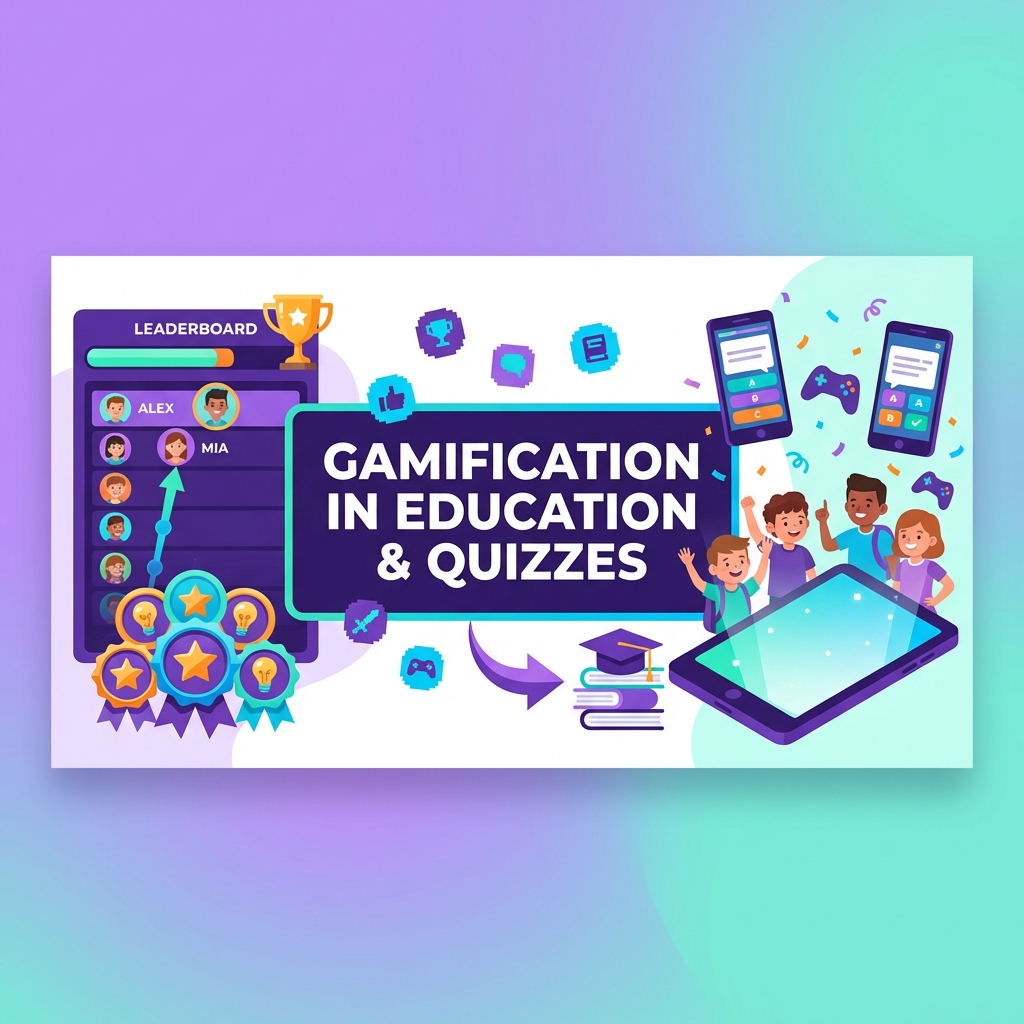
Walk into any classroom running a live quiz game—the kind where students answer questions on their phones and a leaderboard projects at the front of the room—and you will notice something striking. The energy level is completely different from a typical lesson. Students are leaning forward, whispering strategy with partners, groaning when they get one wrong, and celebrating when they climb the rankings. This is gamification at work, and it is not just entertaining. The research shows it genuinely improves how much students learn and retain.
Gamification in education means applying game-design elements—points, competition, immediate feedback, levels, streaks—to learning activities. It does not mean turning every lesson into a video game. It means understanding why games are so effective at holding attention and applying those principles strategically to educational contexts. When done well, gamified assessments transform quizzes from anxiety-inducing tests into activities students actively look forward to.
The Psychology Behind Gamified Learning
Games work because they tap into fundamental psychological drives that evolution has hardwired into human brains. Understanding these drives helps explain why gamified quizzes produce better results than traditional assessments.
The first drive is competence—the desire to master skills and overcome challenges. When a quiz provides immediate feedback on each answer, students experience a rapid cycle of attempt, feedback, and adjustment. This tight loop is the same mechanism that makes video games so compelling. Each correct answer provides a small burst of satisfaction, while each incorrect answer creates a productive desire to understand why.
The second drive is autonomy. Gamified quizzes often give students more control over their learning experience than traditional tests. They can choose when to practice, set their own goals, and track their progress. This sense of ownership increases intrinsic motivation—students study not because they have to, but because they want to improve their performance.
The third drive is relatedness—the social dimension. Leaderboards, team competitions, and collaborative quiz games create a shared experience that builds community. Students are not just learning in isolation; they are learning together, which research consistently shows improves both motivation and recall.
What the Research Actually Says
Let's cut through the hype and look at data. A 2019 meta-analysis published in Educational Research Review examined 46 studies on gamification in education and found a statistically significant positive effect on learning outcomes, with particularly strong effects on student engagement and motivation. Importantly, the benefits were consistent across age groups and subject areas.
A separate study from the University of Colorado found that learners in gamified programs scored 14 percent higher on skill-based assessments and 11 percent higher on factual knowledge assessments compared to control groups using traditional methods. They also retained information longer—a critical finding that separates genuinely effective methods from those that only produce short-term gains.
However, it is important to note that not all gamification works equally well. The same research literature identifies surface-level gamification—simply adding points and badges without meaningful integration—as largely ineffective or even counterproductive. The key is aligning game elements with learning goals, not decorating traditional activities with game-like visuals.
Effective Gamification Strategies for Quizzes
Based on both research and practical classroom experience, these strategies consistently produce positive results:
- Immediate feedback — Show whether each answer is correct or incorrect right after submission. Do not make students wait until the end. Immediate feedback is the single most important gamification element for learning.
- Progress visibility — Let students see how far they have come, how many questions remain, and how their understanding is growing over time. Progress bars and completion indicators maintain motivation through longer quizzes.
- Streaks and momentum — Reward consecutive correct answers with streak indicators. This encourages careful thinking and builds confidence as students see their knowledge demonstrated in real time.
- Competitive elements with care — Leaderboards and rankings can motivate, but they can also discourage struggling students. Consider team competitions, anonymous leaderboards, or 'beat your own best score' approaches that provide competitive motivation without public embarrassment.
- Multiple attempts — Allow students to retake quizzes, encouraging mastery rather than one-shot performance. Each attempt should feel like a chance to improve, not a repetition of failure.
- Explanations for wrong answers — When a student selects an incorrect option, show them why it was wrong and what the correct answer is. This transforms mistakes from punishments into learning moments.
Live Quiz Games: A Special Case
Live quiz games—where students answer questions simultaneously in real time, with results displayed on a shared screen—deserve special attention because they combine gamification with social learning in a uniquely powerful way. The shared experience of competing together, the time pressure that creates urgency, and the collective energy of a room full of engaged learners creates conditions that traditional assessments simply cannot replicate.
Teachers consistently report that live quiz sessions are among the most engaging activities in their repertoire. Students who rarely volunteer in class discussions become active participants when the format shifts to a game-based quiz. The low stakes—it is a game, after all—reduce anxiety while the competitive element maintains focus.
Platforms like AdvanceQuiz support live quiz hosting where a teacher controls the pace, questions are displayed one at a time, and a real-time leaderboard tracks performance. Students join using a simple code, answer on their own devices, and compete for top positions. After the session, the teacher has detailed analytics showing which questions were most challenging and which students need additional support.
When students are having fun, they do not realize how hard they are thinking. That is the real power of gamification—it disguises effortful learning as enjoyable activity.
— Dr. Karl Kapp, Professor of Instructional Technology, Bloomsburg University
Avoiding Common Gamification Pitfalls
Gamification can backfire when implemented carelessly. Watch out for these common mistakes:
- Overemphasizing competition — Some students thrive on competition; others are demolished by it. Always provide pathways for students who prefer self-paced, non-competitive engagement.
- Rewarding speed over accuracy — If your quiz game awards more points for faster answers, students may rush and stop thinking carefully. Consider weighting accuracy more heavily than speed.
- Making it feel trivial — There is a fine line between fun and unserious. Students should feel that the content matters even though the format is enjoyable.
- Ignoring intrinsic motivation — Points and prizes get attention, but lasting motivation comes from genuine understanding and mastery. Use external rewards sparingly and always connect them to learning goals.
- One-size-fits-all approach — Different students respond to different motivational structures. Offer variety in your gamification approaches throughout the term.
Gamification Beyond K-12: Corporate and Higher Education
Gamified quizzes are not just for school children. Corporate training programs have adopted gamification extensively, using quiz competitions for compliance training, product knowledge assessments, and team building. The results in professional settings mirror those in educational research—higher engagement, better knowledge retention, and more positive attitudes toward mandatory training.
In higher education, professors use gamified quiz platforms for large lecture courses where individual attention is impossible. When 200 students in an auditorium simultaneously answer quiz questions and see the class-wide results projected on screen, even the most disengaged student in the back row tends to pick up their phone and participate.
Measuring the Impact
How do you know if your gamification efforts are working? Look beyond quiz scores. Track participation rates, voluntarily completed attempts, time spent on review activities, and student feedback. Compare engagement levels in gamified versus non-gamified units. If students are completing practice quizzes that are entirely optional, that is a strong signal that gamification has tapped into intrinsic motivation.
Most importantly, check whether improved engagement translates into improved understanding. Gamification that increases activity without increasing learning is just entertainment. The goal is always to use engagement as a vehicle for deeper understanding.
Getting Started with Gamified Quizzes
Start simple. Take a quiz you already use and add immediate feedback, a progress indicator, and the option to retry. These three changes alone introduce the core gamification elements that research identifies as most effective. From there, experiment with live quiz sessions, team competitions, and streaks.
The beauty of gamified assessment is that it makes learning more enjoyable for students while giving teachers richer data about understanding. When everyone is more engaged—students in learning, teachers in analyzing results—education works better for all involved.
Ready to Transform Your Quiz Creation?
Join thousands of educators using AI to create engaging assessments in seconds.
Get Started Free