Most educators assess their students regularly, but far fewer have an intentional assessment strategy—a coherent plan for when to assess, how to assess, what to do with the data, and how all the pieces fit together. Without this strategy, assessment becomes a collection of disconnected events: a quiz here, a project there, a final exam at the end. Each one measures something, but the aggregate does not tell a cohesive story about student learning.
Building a genuine assessment strategy requires stepping back from individual tests and thinking about the entire learning journey. What do you want students to know and be able to do by the end of your course? How will you know they are on track at each stage? What will you do when data shows they are not? These questions, answered thoughtfully, produce an assessment approach that actively improves learning rather than merely measuring it.
Start with the End: Backward Design
The most effective assessment strategies begin with the end in mind—a principle known as backward design, developed by Grant Wiggins and Jay McTighe in their influential framework 'Understanding by Design.' Instead of planning lessons first and figuring out assessment later, you start by defining what students should know and be able to do at the end of the unit, course, or program.
From there, you design assessments that would constitute evidence of that learning. And only then do you plan the instruction that will prepare students to succeed on those assessments. This sequence—goals, then assessments, then instruction—ensures alignment. Every quiz, project, and exam exists for a specific purpose within the larger plan.
In practice, this means asking three questions before creating any assessment: What specific learning outcome does this measure? How does this assessment connect to the overall goals of the course? What will I do with the results? If you cannot answer all three, the assessment may not be worth the time it takes.
Balancing Formative and Summative Assessment
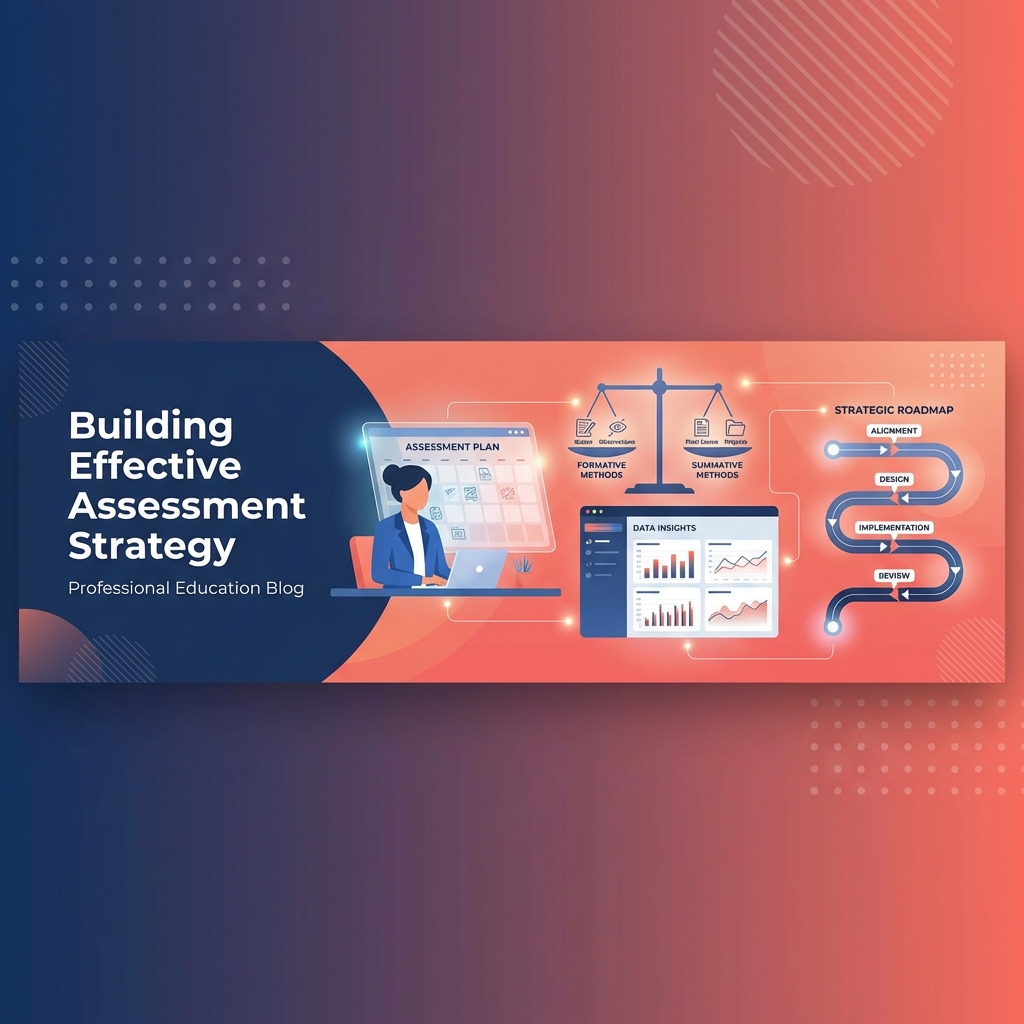
A robust assessment strategy includes both formative assessments (ongoing checks during learning) and summative assessments (evaluations at the end of a learning period). The ratio matters. A strategy heavy on summative assessment tells you what students learned but gives limited opportunity to intervene. A strategy heavy on formative assessment provides constant feedback but may lack reliable evidence of achievement.
A well-balanced approach might allocate 60 to 70 percent of assessment activity to formative methods—daily quizzes, exit tickets, peer discussions, draft reviews—and 30 to 40 percent to summative methods—unit tests, final projects, portfolios. The formative work guides instruction in real time, while the summative work provides accountability and certification.
- Daily or near-daily formative checks (5 minutes each) — Quick quizzes, polling questions, or short writing prompts that reveal understanding in real time.
- Weekly formative assessments (15-20 minutes) — Slightly longer quizzes or problem sets that cover the week's material and help students consolidate learning.
- Unit summative assessments — End-of-unit tests or projects that evaluate mastery of a complete topic. Use results for grading and to inform future instruction of the same unit.
- Cumulative assessments — Midterms or finals that require students to integrate knowledge across multiple units. These reveal whether isolated learning has been connected.
- Performance-based assessments — Projects, presentations, or demonstrations where students apply knowledge authentically. These are especially valuable for assessing higher-order skills.
Designing Effective Quizzes for Your Strategy
Quizzes are the workhorse of most assessment strategies because they are quick to create, quick to take, and quick to analyze. But not all quizzes are created equal. Effective quizzes for an assessment strategy share several characteristics.
First, they align with specific learning objectives. Each question should trace back to a stated goal. If a question does not measure something you are actively trying to teach, remove it. Second, they span cognitive levels. Include questions that test recall, understanding, application, and analysis—not just one level. Third, they provide actionable data. When you grade a quiz, you should learn something useful about what students need next, not just whether to enter a number in the gradebook.
AI-powered quiz generators are particularly useful here because they can produce questions at specified cognitive levels from your source material, saving the significant time required to write varied, well-crafted questions manually. Tools like AdvanceQuiz can generate an entire quiz aligned with specific content in under a minute, giving you a strong draft to refine rather than starting from a blank page.
Using Assessment Data—Not Just Collecting It
This is where most assessment strategies break down. Schools collect enormous amounts of data—quiz scores, test results, assignment grades, attendance records—but remarkably little of it is used to actually change instruction. Data sitting in a gradebook is just numbers. Data analyzed and acted upon is intelligence.
After each formative assessment, ask two questions: What does the class as a whole need? What do individual students need? If 70 percent of the class missed questions about cellular respiration, the class needs reteaching. If three specific students consistently struggle with word problems, those students need targeted intervention.
Create a simple system for translating data into action. This does not require sophisticated software—a spreadsheet tracking which concepts each assessment covered and how the class performed is sufficient. Over time, patterns emerge that guide your teaching decisions with precision you could not achieve through intuition alone.
Assessment should be an ongoing conversation about learning, not a periodic audit. When teachers treat assessment data as a living resource rather than a final verdict, student outcomes improve because instruction becomes responsive.
— Rick Stiggins, Founder of the Assessment Training Institute
Involving Students in the Assessment Process
One of the most underused strategies in education is involving students in understanding and owning their assessment data. When students track their own progress, set their own learning goals based on quiz results, and reflect on what they do and do not understand, they develop metacognitive skills that serve them far beyond any single course.
Practical approaches include having students graph their quiz scores over time, maintain learning journals where they analyze their mistakes, and participate in goal-setting conferences where they identify specific areas for improvement. Students who understand why they are being assessed and how the data serves their learning are more engaged and more motivated to improve.
Avoiding Assessment Overload
More assessment is not always better. There is a real risk of over-testing, where frequent assessments become a source of stress rather than a learning tool, and where the time spent administering and grading assessments displaces actual instruction.
The antidote is purpose. Every assessment in your strategy should exist for a clear reason. If a quiz does not inform your teaching or improve student learning, it is busy work—for you and for your students. Ruthlessly eliminate assessments that do not pull their weight. A thoughtful assessment strategy is streamlined, not stuffed.
Assessment Strategy for Different Contexts
Assessment strategies need to be adapted to context. A high school math teacher working with 150 students across five sections has different constraints than a university professor with 30 graduate students. A corporate trainer assessing compliance knowledge operates under different rules than a kindergarten teacher evaluating fine motor skills.
What remains constant across contexts is the framework: define goals, design aligned assessments, collect data systematically, use data to improve instruction, and iterate. The specific tools, frequencies, and formats will vary, but the underlying logic holds.
Building Your Assessment Calendar
A practical step for implementing your strategy is mapping assessments onto a course calendar. Plot your summative assessments first—unit tests, midterms, finals, major projects. Then fill in formative assessments around them, increasing frequency as summative deadlines approach. Ensure that no week is so assessment-heavy that it crowds out instruction, and that no multi-week stretch is so assessment-light that learning gaps go undetected.
Share this calendar with students at the start of the course. Transparency removes surprise, reduces anxiety, and helps students plan their study time effectively. When students know a quiz is coming, they prepare—which is itself a learning event.
Iterating and Improving Your Strategy
No assessment strategy is perfect on the first try. At the end of each term, review what worked and what did not. Which formative assessments produced the most useful data? Which summative assessments genuinely reflected learning? Were there topics where assessment data consistently showed gaps that instruction could not close?
Use these reflections to refine your strategy for the next iteration. Over several cycles, your assessment approach becomes increasingly precise, efficient, and effective. This iterative improvement is itself a form of assessment—you are evaluating your own teaching practice and adjusting based on evidence.
The Bigger Picture
An effective assessment strategy does more than measure learning—it drives learning. When assessments are frequent, varied, aligned with goals, and followed by responsive instruction, students learn more deeply and retain knowledge longer. The data generated by a good strategy gives educators the information they need to teach with precision, intervene early, and continuously improve.
Start with your goals, design assessments that truly measure them, use the data actively, and refine your approach over time. With modern tools that make quiz creation and data analysis faster than ever, building a strong assessment strategy is not just possible—it is more practical than it has ever been.
Ready to Transform Your Quiz Creation?
Join thousands of educators using AI to create engaging assessments in seconds.
Get Started Free