For most of educational history, assessment has worked like a rearview mirror. A student takes a test, receives a grade days or weeks later, and by then the class has moved on to new material. The grade tells you where the student was, not where they are or what they need next. It is a measurement tool, not a guidance system.
AI analytics are changing this fundamentally. By processing assessment data in real time and identifying patterns invisible to the human eye, AI is turning quizzes and tests from backward-looking scorecards into forward-looking navigational instruments. This shift affects not just how we grade but how we teach, how students study, and how institutions allocate resources.
What Traditional Assessment Misses
A student scores 72 percent on a biology exam. What does that number tell you? Almost nothing useful. It does not tell you which concepts the student understands well and which they struggle with. It does not tell you whether the 28 percent they missed represents a single gap (maybe they never understood cell division) or scattered weaknesses across multiple topics. It does not tell you whether they are improving or declining. It certainly does not suggest what the teacher should do differently.
Traditional grading aggregates performance into a single number and discards the rich information contained in individual responses. This is like summarizing a medical checkup as 'you scored 74 percent healthy'—technically a summary, but practically useless for treatment decisions.
Teachers have always tried to look beyond the numbers. Experienced educators review individual answers, notice patterns, and adjust instruction accordingly. But this manual analysis takes enormous time. With 30 students, five classes, and a 20-question quiz, that is 3,000 individual responses to analyze. Even the most dedicated teacher cannot do this thoroughly for every assessment.
How AI Analytics Process Assessment Data
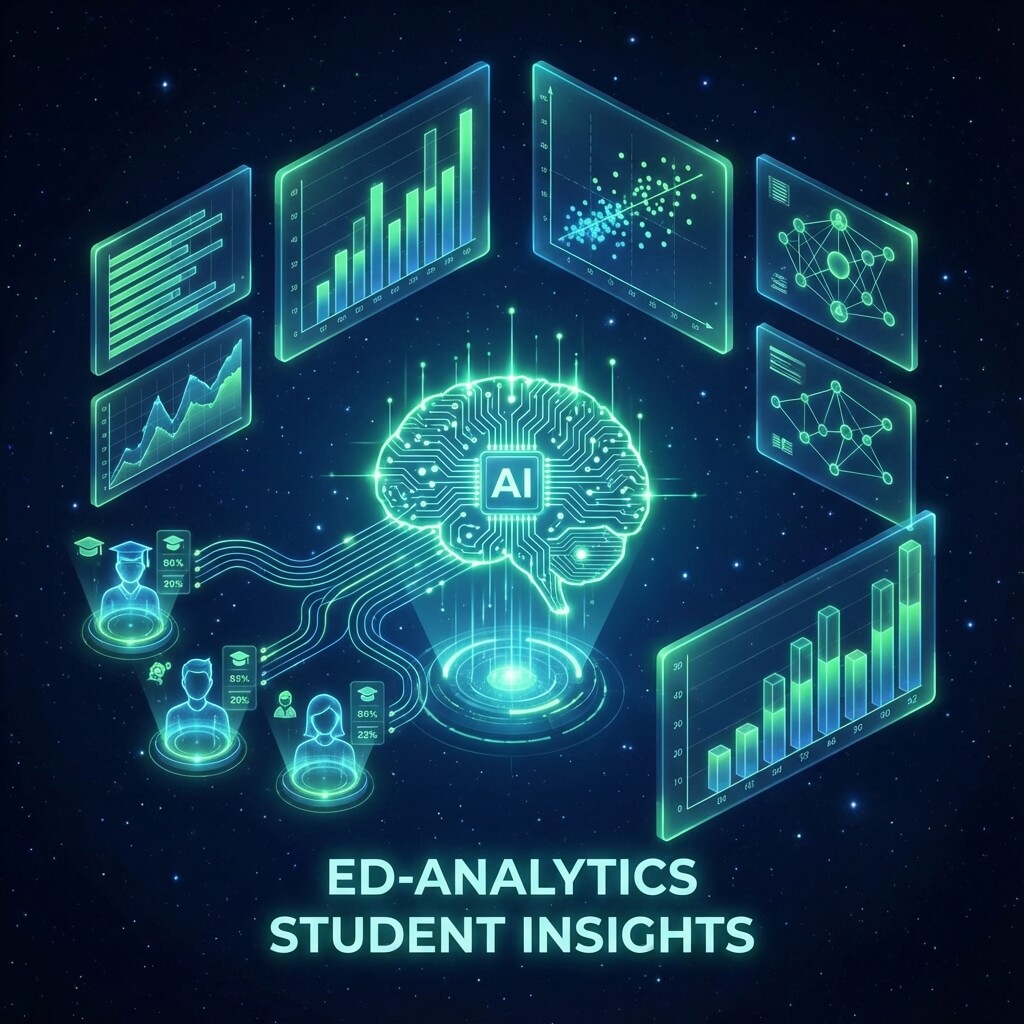
AI analytics systems do what teachers intuitively want to do but lack the time for: they examine every response from every student on every question and find meaningful patterns. The technology works at several levels simultaneously.
- Item-level analysis — For each question, AI calculates difficulty (what percentage got it right), discrimination (does it differentiate between high and low performers?), and distractor effectiveness (are wrong answers revealing specific misconceptions?). Weak questions get flagged automatically.
- Student-level analysis — For each student, AI builds a competency profile showing areas of strength and weakness. Instead of a single grade, the student receives a detailed map of what they understand and what needs more work.
- Class-level analysis — AI identifies concepts that the entire class struggles with, signaling topics that may need reteaching regardless of overall quiz scores.
- Time-series analysis — Over multiple assessments, AI tracks learning trajectories. Is a student improving? Plateauing? Declining? Patterns emerge from as few as three to four data points.
- Predictive analytics — Advanced systems can flag students at risk of falling behind before it becomes obvious from grades alone, enabling early intervention.
From Data to Actionable Insights
Raw data is not insight. The value of AI analytics lies in translating numbers into specific, actionable recommendations. A good analytics system does not just report that 65 percent of students missed question 7—it explains that question 7 tested the application of the ideal gas law, that most students who missed it selected the distractor representing a common unit-conversion error, and that a brief reteaching session focused specifically on unit conversion in gas law problems would likely address the gap.
This specificity distinguishes AI analytics from traditional grade books. The insight is not 'students struggled with this quiz' but rather 'students understand the conceptual relationship between pressure and volume but consistently make errors when converting between Celsius and Kelvin.' The first observation is vague. The second is a specific action plan.
The goal of assessment analytics is not more data—teachers are drowning in data already. The goal is less data but better data: fewer numbers, more meaning, clearer actions.
— Dr. James Pellegrino, Learning Sciences Researcher
Personalized Learning Paths
Perhaps the most transformative application of AI assessment analytics is personalized learning. When a system knows exactly what each student understands and where their gaps are, it can recommend specific resources, practice problems, or review materials tailored to individual needs. Two students in the same class who both scored 75 percent on a quiz might receive completely different recommendations because their specific strengths and weaknesses differ.
This is not science fiction—it is happening now in platforms that combine assessment with content delivery. The key insight is that personalization at scale is impossible for a single teacher managing 150 students but entirely feasible for an AI system processing structured assessment data. The teacher remains central—interpreting results, making judgment calls, providing human support—but the mechanical task of matching students to resources is handled algorithmically.
Real-Time Feedback Loops
Traditional assessment operates on a slow feedback cycle: teach, wait, test, wait, grade, return results, wait, reteach. AI analytics compress this cycle dramatically. When students take a digital quiz, results are available instantly. Analytics are generated immediately. Teachers can adjust their very next class session based on data from the quiz students just took.
Some platforms go further, providing real-time dashboards during an assessment. As students submit answers, the teacher sees a live heat map of comprehension. If a particular question is stumping everyone, the teacher can pause, address the confusion, and then let students continue. The quiz becomes a dynamic teaching tool rather than a static measurement instrument.
This immediacy changes the emotional experience of assessment for students, too. Waiting days or weeks for results creates anxiety and detaches the assessment from the learning. Immediate feedback with explanations turns the quiz into a study session. Student surveys consistently show that real-time feedback reduces test anxiety and increases perceived fairness.
Privacy, Ethics, and Guardrails
AI analytics in education raise legitimate concerns that deserve serious attention. Student data is sensitive. Learning patterns, misconceptions, and performance trajectories are personal information that must be protected with the same rigor as health records. Any analytics platform must comply with FERPA, GDPR, and other applicable privacy regulations, and institutions should carefully evaluate data practices before adoption.
Algorithmic bias is another concern. If an AI system was trained on data from demographically narrow student populations, its predictions and recommendations may not generalize fairly to all students. Institutions should ask vendors about training data, bias testing, and fairness audits. Transparency matters: teachers and students should understand how analytics are generated and have the ability to question or override recommendations.
There is also a risk of over-reliance. AI analytics should inform teacher judgment, not replace it. A system might flag a student as 'at risk' based on quiz data, but the teacher may know that the student was dealing with a family emergency that week. Human context always matters, and any good analytics implementation keeps the teacher in the decision-making seat.
What Institutions Should Consider
For schools and organizations considering AI assessment analytics, several factors merit careful thought. First, the quality of analytics depends entirely on the quality of the assessments feeding data into the system. Well-designed quizzes produce meaningful analytics; poorly designed quizzes produce misleading analytics. Investing in better assessment design should precede or accompany any analytics implementation.
Second, analytics are only valuable if teachers act on them. Professional development around data interpretation and instructional adjustment is essential. A dashboard full of insights that no one reads is an expensive decoration. The tool must integrate into existing workflows, not create additional work.
Third, start small. Pilot analytics with a few willing teachers before a full rollout. Gather feedback, refine processes, and build institutional capacity gradually. The schools that benefit most from analytics are those that treat implementation as a multi-year learning process, not a one-time purchase.
The Bigger Picture
AI analytics represent a shift in the fundamental purpose of assessment. For decades, assessments have served primarily as sorting mechanisms—ranking students, assigning grades, determining advancement. Analytics reframe assessment as a learning mechanism, a tool that helps every student understand their own growth and guides teachers toward the instruction each student needs.
This is not about replacing human educators with algorithms. It is about giving human educators superpowers—the ability to understand 150 students as individuals, to detect learning gaps early, and to tailor instruction with a precision that was previously impossible. The technology is a force multiplier for the expertise and care that good teachers already bring to their work.
The future of assessment is not more testing. It is smarter testing—fewer, better assessments that generate richer insights and drive more effective learning. AI analytics are the engine that makes this possible.
Ready to Transform Your Quiz Creation?
Join thousands of educators using AI to create engaging assessments in seconds.
Get Started Free