
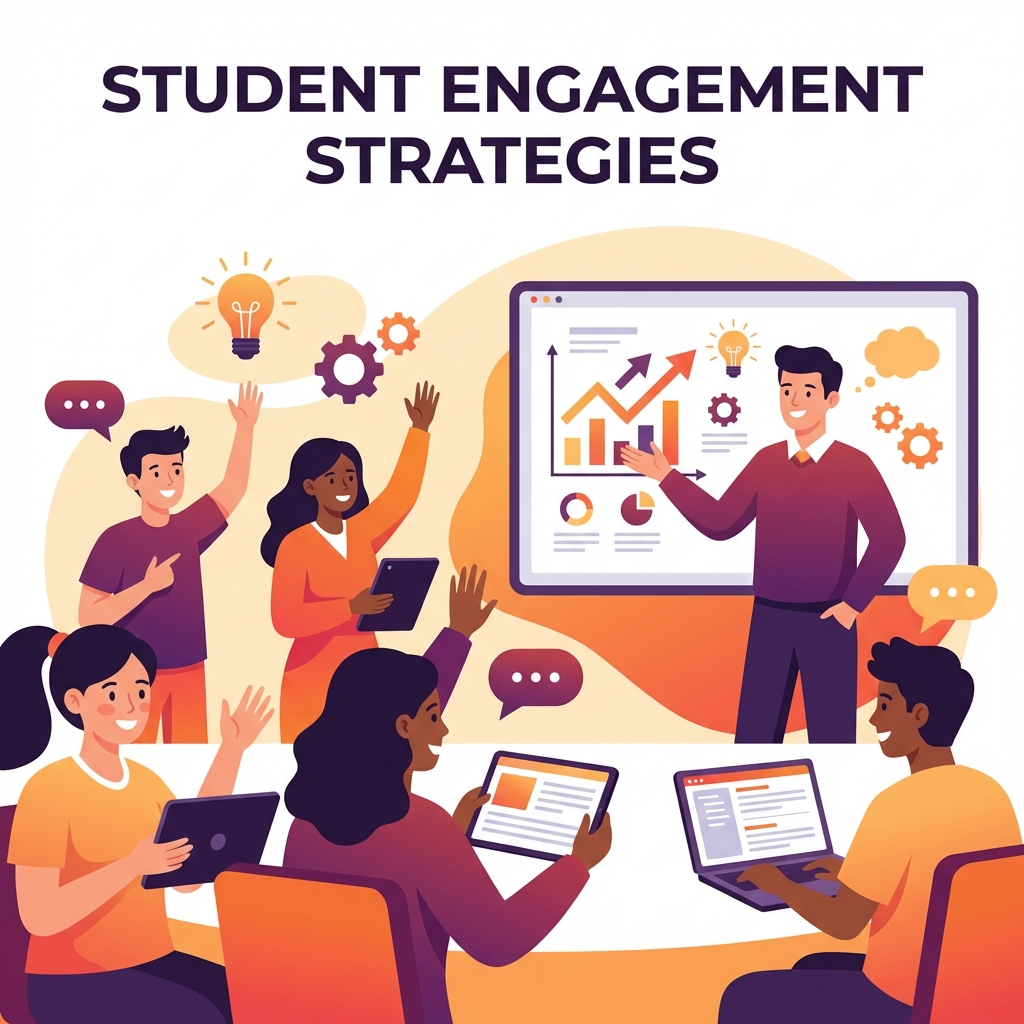
Every seasoned teacher can tell the difference between a class that is merely present and a class that is genuinely engaged. In an engaged classroom, students ask questions without being prompted, they connect new ideas to previous lessons without being reminded, and the energy in the room is focused rather than restless. Getting students to this state consistently is the central challenge of teaching, and it has only grown more complex as attention spans compete with smartphones, social media, and a culture of constant stimulation.
The encouraging news is that teaching strategies for engagement have advanced significantly. We now have a much better understanding—grounded in cognitive science, not just intuition—of what captures and sustains student attention. Many of these strategies are not complicated. They are simple shifts in how lessons are structured, how questions are asked, and how students interact with material. The difficulty lies not in understanding them but in applying them consistently.
What Engagement Actually Means (And What It Does Not)
Engagement is often confused with entertainment. A fun lesson is not necessarily an engaging one, and an engaging lesson does not have to be fun in the conventional sense. Engagement means that students are actively thinking about the material—processing it, questioning it, connecting it to what they already know. A student quietly wrestling with a challenging problem is engaged. A student laughing at a funny video tangentially related to the topic might not be.
Researchers distinguish between three types of engagement: behavioral (participating in activities and attending to tasks), cognitive (investing mental effort and using deep learning strategies), and emotional (feeling interest, curiosity, or investment in learning). The most effective strategies address all three dimensions.
Start Every Lesson with a Hook
The first three minutes of a lesson disproportionately affect engagement for the entire session. If students begin passively—listening to housekeeping announcements or watching you set up—their brains settle into passive mode, and it takes significant effort to shift them out of it.
Instead, start with a thought-provoking question, a surprising fact, a brief poll, or a real-world problem related to the day's topic. When students walk in and immediately face a question they find interesting, their brains activate and stay active. A quick quiz on the previous lesson's content also works beautifully as a hook—it forces active recall, which strengthens memory, while simultaneously re-engaging students with the subject matter.
Break Instruction Into Shorter Segments
Research on attention consistently shows that concentration declines sharply after 10 to 15 minutes of passive listening. This does not mean lessons must be 15 minutes long. It means that within a longer class period, you need to interrupt passive listening with brief active processing moments.
The technique is straightforward: teach for 10 to 12 minutes, then pause for a two-minute activity where students process what they just heard. This might be a partner discussion, a quick writing prompt, a think-pair-share, or a three-question quiz. Then resume teaching for another segment. This rhythm of input-process-input-process maintains attention far better than continuous lecturing.
Use Assessment as an Engagement Tool
Quizzes are typically thought of as evaluation instruments, but they are also remarkably effective engagement tools—when used correctly. Research on the testing effect shows that being quizzed on material produces stronger learning than re-reading or re-listening, even without feedback. When you add immediate feedback, the effect is even stronger.
Low-stakes, frequent quizzes change the entire dynamic of a classroom. Students arrive more prepared because they know they will be quizzed. During the quiz, they are forced into active retrieval, which strengthens memory formation. After the quiz, discussing the answers creates natural opportunities for teaching and clarification. All of this happens in five to ten minutes—time well invested.
- Start class with a quick three-question review quiz on yesterday's content. Discuss the answers as a group.
- Embed quiz questions at transition points between lecture topics. Even one question reactivates attention.
- Use live polling or quiz games as formative checks. The game format adds energy while the content reinforces learning.
- End class with an exit quiz. Students reflect on what they learned, and you see gaps before the next session.
- Use quiz results publicly (without identifying individuals) to spark discussion. 'Seventy percent of you chose B—let's talk about why the answer is actually C.'
Give Students Choices
Autonomy is a powerful motivator. When students feel they have some control over their learning experience, engagement increases measurably. This does not mean letting students choose whether to learn—it means offering meaningful choices within your structured curriculum.
Let them choose which of three essay prompts to write about. Let them select the medium for a presentation—video, slides, poster, or written report. Let them choose when to take a practice quiz within a 48-hour window. Even small choices, like which problem set to start with, create a sense of ownership that passive assignments lack.
Connect Content to Real Life
Nothing kills engagement faster than the perception that material is irrelevant. 'When am I ever going to use this?' is not just teenage defiance—it reflects a genuine cognitive challenge. The brain prioritizes information it deems useful for future situations and deprioritizes information that seems irrelevant.
Making content relevant does not require elaborate simulations. Sometimes it is as simple as explaining why a concept matters before teaching the mechanics. 'Today we are learning about compound interest because understanding it is the difference between building wealth and losing it over your lifetime' is more engaging than 'Open your textbooks to chapter seven.' Framing matters enormously.
Students do not resist learning. They resist being bored. There is an enormous difference, and closing that gap is the teacher's greatest leverage for improving outcomes.
— Phil Schlechty, Founder of the Schlechty Center for Engagement
Build Relationships That Support Engagement
Research consistently identifies the student-teacher relationship as one of the strongest predictors of engagement. Students who feel known, respected, and cared about by their teacher invest more effort in that teacher's class. This is not sentimental—it is practical. Trust enables risk-taking, and learning requires the risk of being wrong.
Building these relationships does not require being a friend or entertainer. It means learning students' names quickly, acknowledging their contributions, showing genuine interest in their perspectives, and creating an environment where mistakes are treated as learning opportunities rather than failures.
Technology as an Engagement Lever
Technology, thoughtfully deployed, can significantly boost engagement. Interactive quiz platforms, live polling, collaborative documents, and discussion boards all create channels for participation that traditional lessons cannot. The key word is 'thoughtfully'—technology used without pedagogical purpose is a distraction, not an engagement tool.
Live quiz games are a particularly effective use of technology for engagement. They combine competition, time pressure, immediate feedback, and social interaction in a format that consistently generates high participation. Even students who never raise their hands in discussion will enthusiastically answer quiz questions on their phones. Platforms like AdvanceQuiz make creating these experiences quick and effortless.
Measuring Engagement
How do you know if your engagement strategies are working? External indicators include participation rates, attendance patterns, question frequency, and assignment completion. Internal indicators require asking students directly—brief surveys, reflective journals, or simple 'How engaged were you today, from 1 to 5?' checks.
Assessment data also tells a powerful engagement story. If quiz scores improve over a semester with consistent effort, engagement is likely high. If optional practice quiz usage increases, students are choosing to engage with material outside of required work—one of the strongest indicators of genuine engagement.
Putting It into Practice
Do not try to implement everything at once. Choose one or two strategies that resonate with your teaching style and your students' needs. Apply them consistently for a month and observe the results. Then add another strategy. Sustainable improvement comes from steady iteration, not wholesale overhaul.
The strategies that consistently produce the strongest results—active retrieval through quizzes, shorter instructional segments, real-world connections, and student choice—all share a common thread: they shift students from passive recipients to active participants. When students are doing the thinking, they are engaged. Build your lessons around that principle and engagement follows naturally.
Ready to Transform Your Quiz Creation?
Join thousands of educators using AI to create engaging assessments in seconds.
Get Started Free