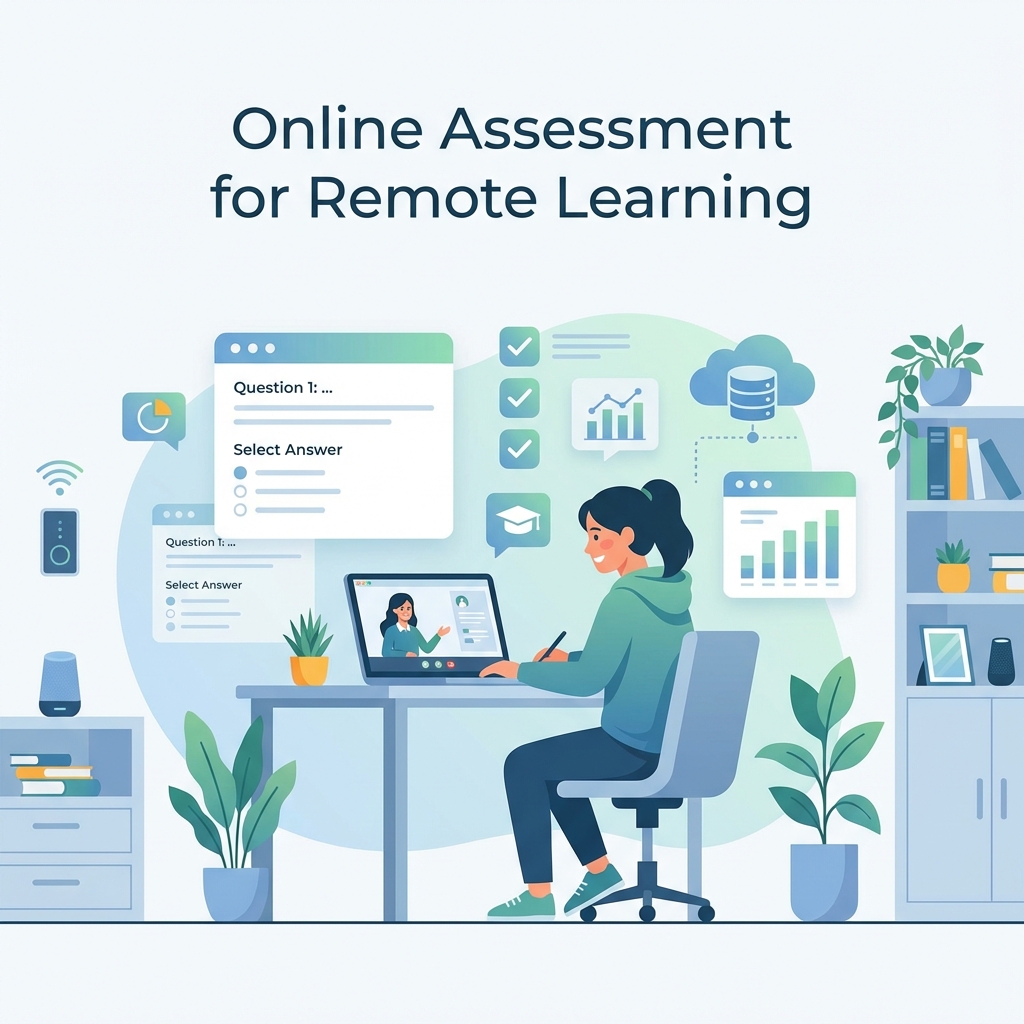
Remote and hybrid learning are no longer temporary emergency measures. They have become a permanent part of how education operates worldwide. Universities offer fully online degree programs, K-12 schools provide virtual options for students who need flexibility, and corporate training programs reach distributed teams across time zones. But while teaching methods have adapted, assessment often lags behind—many educators are still trying to replicate paper exams in a digital environment, and the results are predictably frustrating.
Effective online assessment requires rethinking not just the delivery method but the entire assessment philosophy. What works in a supervised classroom—timed exams, silent rows of students, controlled environments—does not translate well to students sitting at kitchen tables with unrestricted internet access. The good news is that this challenge has pushed educators toward assessment approaches that are arguably better than what they replaced.
The Core Challenge: Integrity Without Surveillance
The first concern most educators raise about online assessment is cheating. It is a legitimate concern—students taking quizzes at home have access to textbooks, search engines, and messaging apps. But the solution most institutions initially reached for—proctoring software that monitors webcams, tracks eye movements, and locks browsers—has proven both unpopular and limited in effectiveness.
A better approach is to design assessments that are resistant to cheating by their nature. If a question can be answered by copying from a textbook or typing it into a search engine, the question is testing recall—something easily outsourced to technology. Questions that require application, analysis, synthesis, and evaluation are inherently more cheat-resistant because they demand original thinking that cannot be quickly Googled.
This does not mean abandoning factual recall questions entirely. They still have a place, particularly in formative assessments where the purpose is self-checking rather than grading. But for summative online assessments, shifting toward higher-order questions produces assessments that are both more cheat-resistant and more educationally valuable.
Designing Cheat-Resistant Online Quizzes
Several practical strategies reduce the incentive and opportunity for academic dishonesty in online settings:
- Question randomization — Draw questions from a large pool and present them in random order. Each student sees a different quiz, making answer-sharing impractical.
- Time constraints — Setting reasonable but firm time limits discourages lengthy searches for answers. If a student genuinely knows the material, time limits are comfortable; if they need to look up every answer, time runs out.
- Open-resource formats — Embrace the reality of online access by designing questions that require applying knowledge, not just recalling it. Tell students the quiz is open-book, then write questions that require understanding, not copying.
- Varied question types — Mix multiple choice with short answer, explanation, and application questions. Copy-pasting an answer to a well-crafted application question is much harder than for a factual recall question.
- Personalized questions — Where possible, include variables or scenarios that differ slightly for each student. Even small variations make sharing answers unreliable.
Choosing the Right Assessment Format
Online assessment is not limited to traditional quiz formats. The digital environment actually opens up possibilities that physical classrooms cannot easily support.
Asynchronous quizzes—available for a window of time for students to complete at their convenience—work well for checking comprehension of readings or lecture material. They reduce scheduling stress and accommodate students in different time zones. Synchronous live quizzes—where everyone participates at the same time—create shared experiences that combat the isolation of remote learning and allow for real-time discussion of results.
Portfolio assessments, where students compile work over time, are particularly well-suited to remote learning because they emphasize process over performance on a single day. Discussion-based assessments, where students engage in structured online debates or peer review, add social learning elements that remote students often miss.
Technical Considerations for Online Quizzes
Technology failures during high-stakes assessments are every online educator's nightmare. A student's internet drops mid-quiz. The platform crashes. A device runs out of battery. Planning for these scenarios is essential.
- Auto-save functionality — Use platforms that save answers as students go, so a disconnection does not erase their work.
- Flexible submission windows — Allow extra time or a makeup opportunity for students who experience verified technical difficulties.
- Low-bandwidth options — Avoid assessment formats that require high-speed internet, such as video responses, unless you are confident all students have reliable connections.
- Device compatibility — Test your quizzes on both desktop and mobile devices. Many remote learners, especially in underserved communities, access coursework primarily through smartphones.
- Clear instructions — Online assessments need even clearer instructions than in-person ones because you are not there to answer procedural questions in real time.
- Practice quizzes — Offer an ungraded practice quiz so students can familiarize themselves with the platform before a graded assessment.
Keeping Remote Students Engaged During Assessment
Remote students face distractions that in-person students do not—home responsibilities, notification-rich devices, the temptation of being unsupervised. Designing assessments that hold attention is critical.
Shorter, more frequent assessments outperform long, infrequent ones in remote settings. A 10-question quiz twice a week is more effective and less stressful than a 50-question test once a month. The frequent touchpoints keep students connected to the material and provide regular feedback on their understanding.
Incorporating multimedia elements—images, short video clips, diagrams—into quiz questions adds variety and engages visual learners. Including real-world scenarios and case studies makes assessments feel relevant rather than abstract, which helps maintain focus.
The best online assessments do not try to recreate the classroom test experience. They leverage the unique affordances of the digital environment to assess more authentically and engage students more deeply.
— Dr. Michelle Miller, Author of 'Minds Online: Teaching Effectively with Technology'
Providing Meaningful Feedback at a Distance
Feedback is always important, but it becomes critical in remote settings where students cannot pop by your office for clarification. Online quiz platforms that provide automatic feedback on each question partially address this need—students see immediately why their answer was correct or incorrect without waiting for the instructor to grade manually.
For more substantial feedback, consider recording short audio or video comments. Research shows that students perceive audio and video feedback as more personal and helpful than written comments, even when the content is identical. A two-minute audio recording explaining common mistakes is faster for you to create than typing the same feedback and more impactful for students to receive.
Equity and Access in Online Assessment
Online assessment can inadvertently widen equity gaps if not designed thoughtfully. Students without reliable internet, quiet study spaces, or up-to-date devices face disadvantages that have nothing to do with their knowledge or ability.
Flexible timing—allowing students to take quizzes anytime within a multi-day window—accommodates those with work schedules, caregiving responsibilities, or shared devices. Downloadable quizzes that can be completed offline and submitted later serve students with intermittent connectivity. Offering accommodations proactively rather than requiring students to request them reduces stigma and ensures more equitable assessment.
Building a Sustainable Online Assessment Workflow
Creating online assessments can be time-intensive, especially when building question banks and writing original questions for each unit. AI-powered tools dramatically reduce this burden. Platforms like AdvanceQuiz can analyze your course materials—lecture notes, readings, slides—and generate quiz questions automatically, giving you a strong starting point that you refine rather than create from scratch.
Building reusable question banks is another investment that pays off over semesters. Each time you teach a course, add strong questions and retire weak ones. Over a few iterations, you build a robust bank that allows randomized quizzes with minimal ongoing effort.
Putting It All Together
Online assessment is not just a necessity for remote learning—it is an opportunity to assess more effectively, more frequently, and more equitably than many traditional approaches allowed. By designing assessments that prioritize application over recall, providing immediate feedback, maintaining academic integrity through smart design rather than surveillance, and leveraging AI tools to reduce workload, educators can create assessment experiences that genuinely serve learning.
The shift to online assessment may have been forced by circumstances, but the improvements it enables are here to stay. Embrace the change, invest in tools and strategies that work, and your students—wherever they are sitting—will learn more effectively because of it.
Ready to Transform Your Quiz Creation?
Join thousands of educators using AI to create engaging assessments in seconds.
Get Started Free